
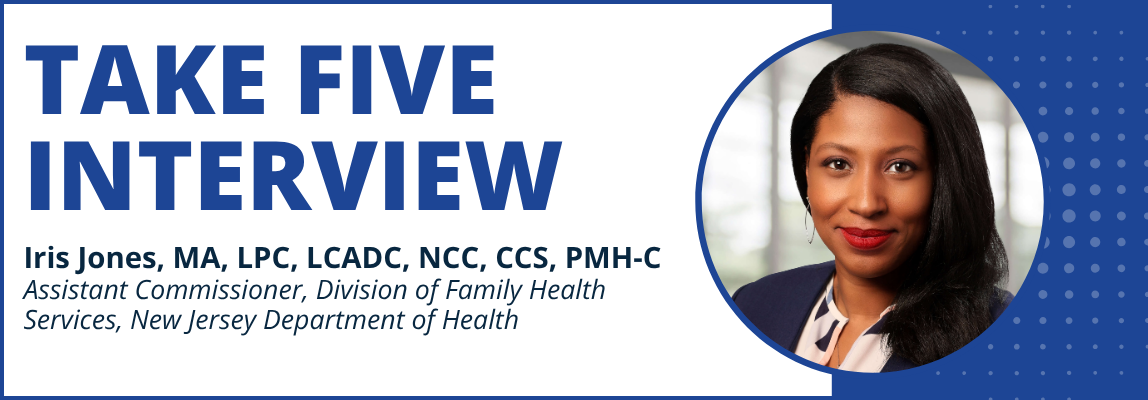
Iris Jones is the Assistant Commissioner for the Division of Family Health Services at the New Jersey Department of Health. She joined the Department as Executive Director of Women’s Health and was promoted to her current role last fall. Before moving into public health, she co-founded the Cooper Center for Healing EMPOWR clinic that provides integrative care to pregnant and parenting women with substance and mental health conditions.
What drew you to your current role at the Department of Health?
I really just saw an opportunity to expand some of the evidence-based work I’ve done on the ground. I love being able to create programs and health care opportunities that support the community. There is so much innovation happening in the family health space, and it presented me with a unique opportunity to help those most in need. I get to go to work knowing my work is going to make a difference for someone. It’s why I became a therapist, and it’s why I moved into public health — so I could scale that work beyond just the couple of patients I could see in a week.
What are your policy recommendations for improving maternal and children’s care in New Jersey?
I think we’ve seen a lot of policy change over the years, and I’d love to see us move into a space where we’re implementing those changes and tracking their efficacy. I’m excited to see growth in the midwifery space, Midwives are such a valuable asset in combating maternal morbidity and mortality. I’m interested in how we incentivize models that provide whole-person care and address the social drivers of health, while simultaneously tracking how effective they are, and how outcomes are changing.
If there were only one policy I could create, it would be around streamlined health care — how we move a person through a health system in a way that makes sense for them and their family. Right now, things are so broken up. I really want to see more holistic care models where we address all the needs that our patients show up with every day, as best we can.
Is there a recent initiative or project you’re especially excited about?
There’s so much wonderful work happening throughout New Jersey. One of the things I’m most excited about is the Perinatal Center of Excellence we’re hoping to build. It would allow a holistic, longitudinal care model where people can get their medical care, addiction care, mental health care, obstetric and pediatric care all in one space that feels comfortable and safe for them.
I’m also excited to lift up the work of our community partners. There are several initiatives happening to help the health of women and families, and we’re working towards a space where everyone in the community knows what’s available to them— that’s the idea behind the Women’s Health Hub we’re building. It will be a virtual resource where people can get accurate, up-to-date information that is evidence-based, from a trusted source.
We also put out a grant opportunity this year to increase reproductive health access, and we were thrilled to see how many organizations applied. We’re expanding Team Birth and assisting in AIM bundle implementation in hospitals, and working on postpartum mental health follow-up. There’s a lot of different things going on, and I’m thrilled about the direction that the division is moving as a whole.
Is there an opportunity you think we’re missing as a state that could improve health outcomes in New Jersey?
There are a lot of opportunities for us to grow. New Jersey is very siloed, and we need stronger relationships and partnerships — with our health systems, our community-based organizations, and our communities themselves. Health and social drivers of health are complex. I’m excited to see the expansion of social medicine because it speaks to this — if people are going into emergency departments because they’re hungry, and we can’t just address one side of the equation and not the other.
I’m excited to watch more FQHCs take up the work of addressing social drivers — if they’re 80 percent of health, we need to be actively working on them as much as we work on medical health. Our systems need an overhaul, and if we could streamline health care and make it easier for people to access, we’d see healthier communities grow.
Finally, we like to ask a question beyond each person’s professional life: if you had to choose, who would be your real-life hero?
As a therapist, I see a little bit of hero in most people. There are so many people I admire; it’s impossible to pick just one. I want a little of Maya Angelou’s resilience — the way she showed up with her words in a way that made reading something feel like the most amazing thing you did all day. I want courage the way Brené Brown has it. I want to change systems like Thurgood Marshall. I want tenacity like Harriet Tubman. And if I can steal a little of Michelle Obama’s elegance, or the bravery of Ruby Bridges, I can look back on my life and be my own real-life hero — because I emulated the heroes who came before me.