
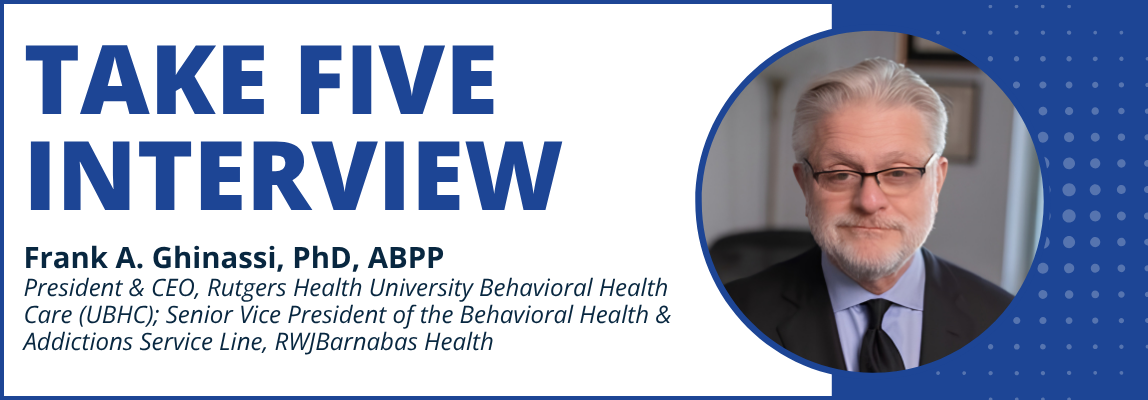
Frank A. Ghinassi, PhD, ABPP, is President and CEO of Rutgers Health University Behavioral Health Care (UBHC) and Senior Vice President of the Behavioral Health and Addictions Service Line at RWJBarnabas Health. He is a new member of the Quality Institute’s Board of Directors. Before joining Rutgers, he was Vice President for Quality, Patient Safety and Regulatory Compliance at Western Psychiatric Institute and Clinic at the University of Pittsburgh Medical Center, and an Associate Professor of Psychiatry at the University of Pittsburgh School of Medicine.
As a new member of the Quality Institute’s Board of Directors, what aspects of the Quality Institute’s work are you most excited to be involved in?
I’m really excited about the work that’s recently been done looking at children’s systems of care and behavioral health. The Children’s Mental Health Mapping Report that came out recently highlights many areas of concern that those of us in the field share. The Quality Institute took this project on and investigated these issues through the eyes of many stakeholders. And their continued interest in putting together meaningful dashboards that address access, process, and hopefully outcomes — are very exciting issues for me.
As President and CEO of Rutgers Health University Behavioral Health Care, what are your top one or two priority focus areas for improving access to mental health in New Jersey?
I’m excited about the training I’m part of and that I observe at Rutgers and across the RWJBarnabas Health system, where interdisciplinary care is becoming woven into healthcare. The future of access will be about multidisciplinary teams delivering care, together — combinations of physicians, advanced practice nurses, psychologists, social workers, master’s-level counselors, and increasingly, peer specialists and peer navigators with lived experience.
As it now stands, a huge percentage of behavioral health interventions, especially pharmacologic, happen in offices that don’t say “behavioral health” outside — they say primary care, pediatrics, obstetrics, oncology and cardiology. Embedding behavioral health expertise into settings where people are already seeking other physical health care is going to broaden access. Behavioral and physical health are co-travelers. We don’t experience them in ourselves as two separate things, and delivering care in a unified way is more consistent with how we experience our own health.
What do you think the Quality Institute’s role is as a convener of all the stakeholders in healthcare, and what role can we play in advancing this kind of work?
I think the Quality Institute can help with many things. Number one is to help explore or influence longstanding cultural approaches. Many people are still trained in silos, and part of what we need is to move the culture and training toward working in a more interdisciplinary way. Another piece is influencing training institutions to teach that way, so it’s built part and parcel into the next generation of providers worldview.
And finally, while there are emerging payment mechanisms for integrated care, it’s a bumpy frontier — uneven, difficult to navigate, and it varies from payer to payer. Exploring and reducing that variation is something the Quality Institute can help with, looking at how to simplify it and remove payment barriers, so integrated care isn’t a challenge but is in fact the easiest way to deliver and be reimbursed for treatment.
What steps would you recommend New Jersey take to build and sustain the mental health workforce needed to serve children and adolescents?
You don’t hear of many cardiothoracic surgeons who aren’t on insurance plan panels, or orthopedic surgeons as an additional example. People wonder why community-based, private behavioral health providers are not on these same insurance panels as their other doctors. It’s often because the payment structures and rates for behavioral health treatment are dramatically different and lower than the rates and structures for what we think of as “medical care.” There’s a flaw in that thinking, because psychiatric and psychological care is also medical care — it’s just medical care of a different aspect of the patient. We have generations of stigma that have mistakenly considered behavioral health care as not quite the same as physical healthcare, as if seeking and needing behavioral health care is discretionary, not critically necessary. These barriers need to be challenged and removed.
That stigma has led to enormous disparities in insurance payment. The standard of living you can achieve through Medicare, Medicaid, or commercial insurance for delivering behavioral health care services and treatments is dramatically different than in other medical specialties. Mental health clinicians have mortgages to pay, children to put through college, just like other medical professionals, and they must choose if they want to accept the lower traditional insurance (private and public) rates. Many decide not to participate.
Looking back on your years in sports psychology, is there anything that’s stayed with you or that people might not realize about being a sports psychologist?
I spent probably 15 years involved in sports psychology work — as a player educator with the NFL, as a team psychologist with two professional teams in Pittsburgh, and at the University of Pittsburgh, where we developed a contract to deliver the behavioral health services for the 600 athletes there (and later for the 400 athletes at Duquesne University).
Something many people don’t think about, but that’s germane to the Quality Institute’s work, is that professional sports teams define, year after year, what constitutes quality and excellence. What most people don’t see while watching a game is everything that happens leading up to that event. Athletes perform at the level they do because in between those few hours of game time, they’re watching 20 or 30 hours of film. They’re watching their own performance, and the team they’re about to play. They spend hours practicing maneuvers that look like magic when you watch it on television, but that catch they made two feet from the sideline, they made it 200 times in practice the week before.
What I learned from that is that as healthcare professionals, the quality we want to provide for our patients and families requires that same dedication — looking at our own performance, practicing, getting feedback. It’s about treating your skill set as something you’re constantly building on, not something you learn once and then perform. That’s one of the lessons professional sports taught me. Elite athletes aren’t concerned about what their skill level was last week — they’re concerned about how they can make it better in the week ahead.