
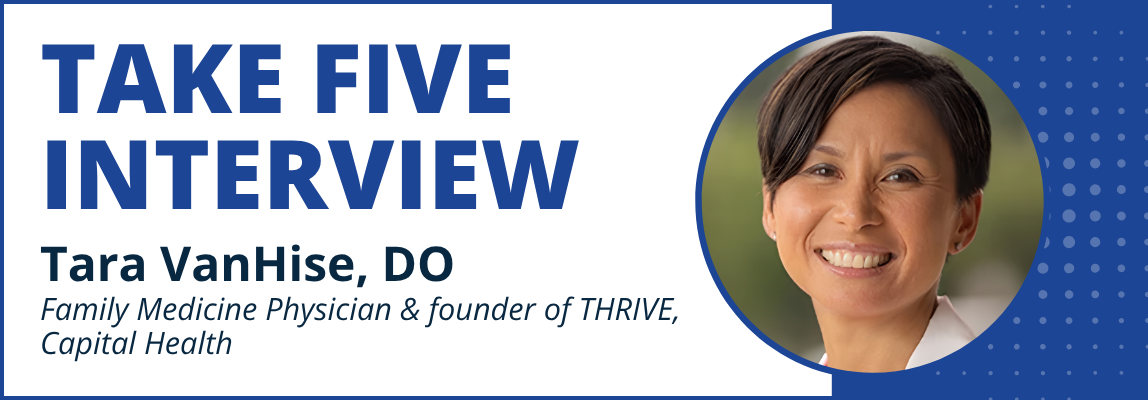
Dr. Tara VanHise, DO, is a family medicine physician with Capital Health and the founder of THRIVE, the health system’s program for physician and health care professional wellness. Capital Health is a member of the Quality Institute’s Provider Council.
When and how did Capital Health establish the THRIVE program, and what need was it designed to address?
Officially, the THRIVE program started in October of 2023; that’s when we had our first official meeting. But organically, it started well ahead of that. Around 2018, I attended a conference and a lecture on physician burnout, and a light bulb went off. I thought, “I don’t think we have any kind of support at our hospital system to help our doctors if they’re experiencing burnout.”
I came back and approached the administration and then started educating myself and others on the topic. After the pandemic, we really realized the need for this. Our committee was born in October of 2023. THRIVE is an acronym: Together, Healthy, Resilient, Innovative, Visionary, and Empowered. The purpose is to address and support the health and well-being of our health care professionals, to make sure that those who take care of our community are taking care of themselves.
What are the biggest contributors to clinician burnout and how does THRIVE address those issues?
There are many reasons for clinician burnout, but according to the research, the biggest contributor is bureaucratic tasks. We love to work hard and take care of our patients. But there is a lot of charting, documentation, and paperwork that isn’t part of direct patient care that we do outside the office. Some people call it “pajama time,” when it’s done at night. Other contributors are less prominent but still real: not feeling valued by your system or administrator, and a lack of autonomy with scheduling. Time becomes a currency, and with different phases of life, it’s hard to balance it all. Burnout is pervasive. One thing isn’t going to make it go away; you have to address multiple areas.
Our system is a work in progress, but we approach it in several ways. We use surveys like the Mayo Clinic Wellbeing Index to assess levels of distress and use that information to try to make changes. We also do social events twice a year, as a way to bond and make connections outside the workplace. For crisis management, we’re working on helping those in need with resources. We are also connected with Rise, our hospital’s existing peer support program, so people know who to call if they experience a traumatic work-related event. And we bring in speakers and educational programs for our physicians and health care professionals. We recently had the Dr. Lorna Breen Heroes’ Foundation come talk to our medical staff, through their CMO Dr. Stefanie Simmons, about the state of clinician wellbeing across the country.
Capital Health was one of the first health systems in New Jersey to get the Wellbeing First Champion recognition—a designation from the ALL IN: Wellbeing First for Healthcare coalition, led by the Dr. Lorna Breen Heroes’ Foundation, that honors health systems, hospitals, and state licensure boards that audit and remove intrusive, stigmatizing mental health questions from their credentialing and licensing applications.
What does it take to get that recognition and why is it so significant?
I think half the battle is understanding why something is needed and why is it so impactful. People had to understand why it was important to remove invasive language, how it is impacting our clinicians, and how it impacts the hospital down the road. Ultimately, it was a team approach.
The significance of the recognition is that it saves lives. These types of questions are a primary driver of suicide in the health care workforce, according to the ACA suicide prevention report. And one of the biggest barriers for a physician to seek help is feeling stigmatized — feeling like they’re less than they should be, because there are such high expectations of us. Invasive language on credentialing applications can turn people away from seeking help. If someone had a substance use disorder ten years ago and it’s resolved, or if they’re managing a mental health condition and coping well, that kind of language can dissuade them from applying for a license or a job. Compared to the general population, health care workers are at higher risk of burnout and poor mental health, just because of the nature of the work.
What kind of advice would you give other health systems who want to make clinician well-being a top priority for their organizations?
I think one of the biggest things is approaching it as a team and communicating with everyone who can help you be successful: your colleagues, administration, human relations, public relations, information systems. All of those existing systems at the hospital are going to be players in supporting physicians and other health care professionals. I’m also learning that we already have a lot of resources we just don’t know about, so a lot of it is about communicating what we already have in place so people can actually use it and lean on it.
The ironic part about health care professional wellbeing is that we all take care of everyone else, and the last people we take care of are ourselves. It’s the proverbial oxygen mask. You have to put on your own before you can take care of others. But laying the foundation and communicating the concept of wellbeing is so important to change the culture, and patience and faith in your mission is the key.
Lastly, to get to know you a little better: what are you reading, watching, or listening to right now?
Right now, I’m finishing up the All Souls series by Deborah Harkness, which starts with A Discovery of Witches. I read the book, then I watch the season. I love fantasy and historical fiction. It’s everything I love about books. It’s like Harry Potter meets Outlander meets Twilight. You get to know the characters, you fall in love with them, and it takes your mind elsewhere. The great thing about reading is you can do it anywhere. It’s my sanity, and it’s a great escape. You remember that there are other things outside of work. It’s taken me a long time to understand that, but I hope more people remember that too.
Want your hospital or health system to become a Wellbeing First Champion?
The designation is administered by the ALL IN: Wellbeing First for Healthcare coalition, which is led by the Dr. Lorna Breen Heroes’ Foundation, and free to any health system, medical group, health plan, or licensure board. Begin the process by registering for a free account, then use the toolkit and other resources to audit your credentialing and licensing applications, and finally, submit them for verification.
Learn more and get started at: drlornabreen.org/removebarriers.