
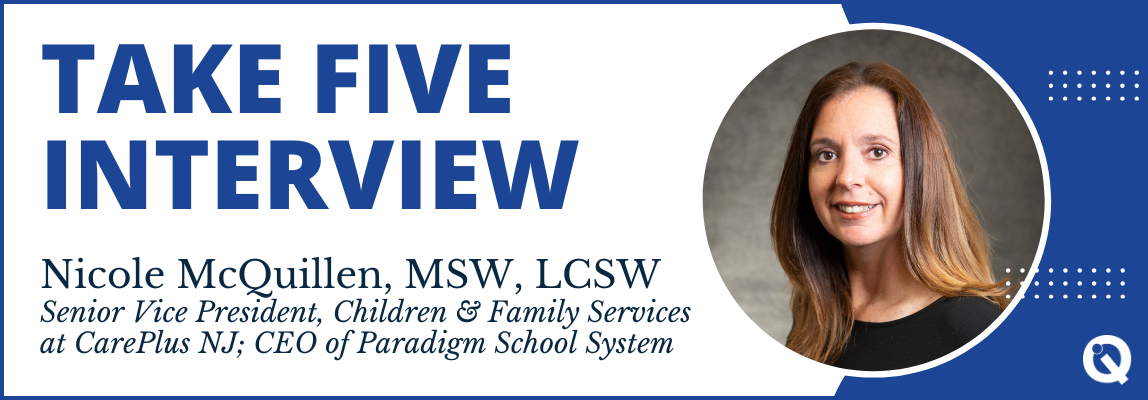
Nicole McQuillen, MSW, LCSW, Senior Vice President, Children and Family Services at CarePlus NJ and CEO of Paradigm School System. CarePlus NJ, a Certified Community Behavioral Health Clinic, is a member of the Quality Institute’s Provider Council.
How does Paradigm fit into your broader mission?
Paradigm School System extends our mission by directly integrating education with behavioral health support. Approved by the New Jersey Department of Education, Paradigm operates both a therapeutic high school and middle school.
Students are referred by their home school district’s child study team when additional support is needed. Districts cover tuition and transportation, and currently, we serve students across Bergen, Passaic, Essex, Morris, and surrounding counties.
Our schools deliver the same academic curriculum as public districts, but with added clinical services — social workers, art and music therapy, and other interventions. If a student is struggling in class, they can step out to meet with a clinician and return ready to learn. Many students face challenges such as anxiety or depression, and this model allows them to succeed academically while addressing their mental health needs.
How does the connection of behavioral health and education shape how you support children and families?
Emotional well-being is the foundation of learning. Students can only thrive academically if they feel safe, supported, and connected. Without addressing issues like anxiety or depression, education alone isn’t enough.
By providing mental health services into the school day, we remove barriers such as stigma, cost, or transportation. Families benefit too — they don’t have to coordinate separate services, and they’re actively involved in treatment, which helps reinforce progress at home. For many parents, this integrated model is what makes access possible.
What lessons from the high school experience shaped the design of the new therapeutic middle school?
At the high school, we often welcomed students who had already been absent from school for long periods. Many arrived withdrawn and uncertain. What made the difference was creating a culture of support where they could move at their own pace, connect with peers, and feel accepted.
Students frequently told us they wished they had that kind of environment earlier. Their feedback inspired us to open a therapeutic middle school, so we could intervene sooner. We also brought several teachers from the high school to help replicate the same culture of acceptance and collaboration. That consistency was key.
How do you envision the transition between the middle and high school programs—both academically and therapeutically?
Transitions are individualized and guided by each student’s Individualized Education Plan (IEP). We hold regular meetings with the student, parents, and child study team to review progress and determine the best path forward.
Some students transition back to their home district within a year, while others remain with us through middle and high school. Our goal is always to support what’s best for the student. Now that we have both schools, students who need ongoing support can remain within Paradigm, ensuring continuity and eliminating disruption in their care and education.
Finally, beyond your professional life, can you share an experience that shaped who you are today?
Early in life, I experienced personal loss, which inspired me to pursue social work and gave me empathy for others navigating hardship.
Another formative experience was running the New York City Marathon. Training for and finishing 26.2 miles reminded me that with discipline and persistence, I can overcome difficult challenges. That mindset carries into my work—when obstacles arise, I draw on the same determination and resilience.