
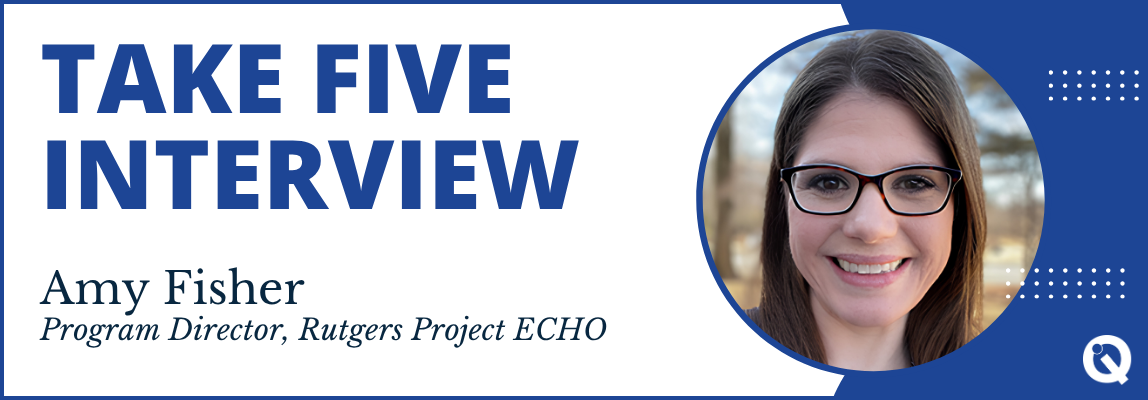
Amy Fisher, Program Director at Rutgers Project ECHO, a member of the Quality Institute’s Education Council, Institutes of Higher Learning.
Project ECHO expands access to specialty knowledge to frontline health care providers in New Jersey. How has the program evolved to address New Jersey’s most pressing health needs?
Since our inception, Rutgers Project ECHO has grown to reach all 21 New Jersey counties. We’ve built strong statewide collaborations and partnerships with community-based organizations, helping us better understand the real-world barriers providers and patients face on the front lines.
For example, during the COVID-19 pandemic, we rapidly launched a Nursing Home ECHO to share best practices and helping nursing homes stay aligned with evolving guidance. We continue to respond to urgent public health priorities — from the overdose crisis to the unacceptable disparities in maternal morbidity and mortality across the state. We aim to create a space where participants learn from one another and where programs address social determinants of health — not just identify them.
How does your work strengthen provider capacity and advance health equity?
We bring specialist knowledge directly to frontline providers, strengthening the primary care workforce with practical tools to manage increasingly complex patients. Project ECHO supports culturally and linguistically appropriate care. When providers feel confident, they are less likely to refer patients to long waitlists for specialists.
We bring together physicians, nurses, social workers, behavioral health professionals, and community-based providers to foster interprofessional, team-based care — incorporating lived experience and patient voices. The program fosters trust and shared decision-making.
For example, in obesity and diabetes care, many primary care providers feel overwhelmed by medication management and related cardiovascular or liver side effects. Through ECHO, they learn what can be managed in their practice and when to refer patients to a higher level of care.
Can you provide an example of where ECHO is having significant impact?
I would highlight our work in maternal and child health, as well as sexual and reproductive health. Our programs expand the confidence and capacity of advanced practice providers, improving access to reproductive health services, including abortion care, and helping providers recognize maternal warning signs in the postpartum period.
We also debunk myths around medication-assisted treatment in the perinatal population. When looking at addiction and child welfare involvement, we’re actively addressing the stigma that prevents people from accessing care.
We’ve also done strong work supporting community health workers, helping them build foundational knowledge to better assist clients in managing chronic conditions at home before they become emergent. In addition, we’re partnering with our School of Social Work in the “aging well” space so individuals can thrive in their communities.
What role does Rutgers ECHO play in supporting accurate information-sharing in today’s health landscape?
We build our programs using peer-reviewed information aligned with continuing medical education standards. We work with trusted leaders who have demonstrated impact in the communities we serve. Misinformation spreads quickly, so we’ve led many sessions focused on debunking myths and translating scientific evidence into practical guidance. This has been especially important in addressing vaccine hesitancy in certain populations.
We like to ask a question beyond professional life: Who is your real-life hero?
My grandmother. She’s been a strong matriarch in our family, and at 93, she continues to embody a deep commitment to justice, decency, and hard work. Growing up, our homes were connected, so I felt her presence every day. She helped shape my path toward public health and my commitment to advancing well-being and equity. When I reflect on my career, I realize how much of that comes from her influence.