
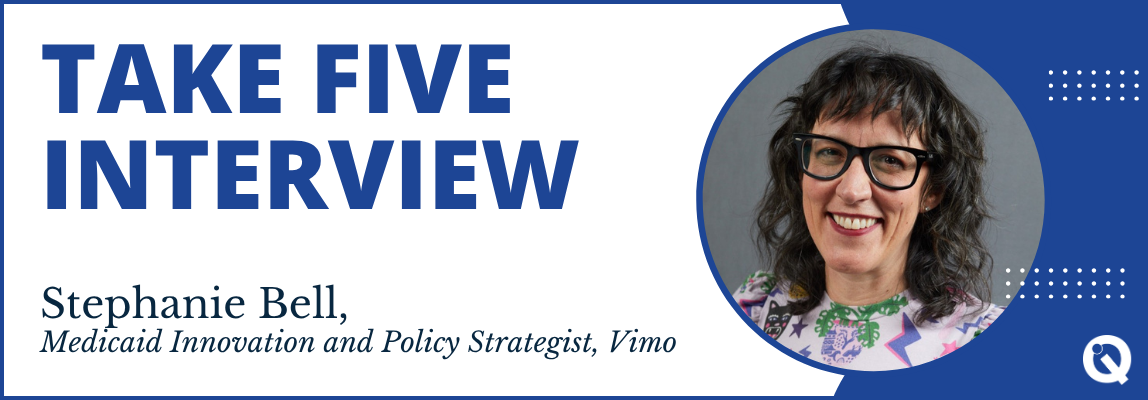
Stephanie Bell, Medicaid Innovation and Policy Strategist, Vimo. Vimo is a member of the Quality Institute’s Professional and Technology Council.
Vimo supported New Jersey’s launch and technical operations of its state-based insurance Marketplace — Get Covered NJ. The launch was smooth and uneventful. What lessons do you draw from that success?
First, we had a strong state partner. Get Covered NJ has been a real success, starting with a state-based subsidy that lowered coverage costs and helped more people enroll. Other states took notice, and it has since become a model. New Jersey was the fourth state we transitioned from the federally facilitated marketplace to a state-based marketplace, and we’ve developed a strong playbook and best practices that we continue to refine.
And I’m a social worker, so I always have to say that launching a new system is not only about the technology and migrating the data, but also about how the system works for people and the business and goals of the state. We make sure that everyone is invested in the program’s success.
Insurance shopping is complicated for consumers. What best practices do you suggest for improving the consumer experience going forward?
Health insurance is not always considered essential in many people’s minds — like food, clothing, or shelter. And that makes it important to have the kind of e-commerce style shopping experience that people expect today. The most successful solution provides people with enough information to help them navigate to what they need without overwhelming them. And that can be a challenge in the insurance space — where there’s so much information. We’re always updating and improving, with advanced tools to help people focus on what’s important to them. You want to provide a snapshot and then let people get to the details they care about. And you must keep in touch with people to understand their experiences and keep up with technology to find opportunities for improvement.
Many consumers struggle with renewals, documentation requests, and transitions between Medicaid and Marketplace coverage. How does your platform help people maintain continuous coverage when their eligibility changes?
One way is to make sure our system leverages the most accurate data sources to prevent consumers from having to submit documentation in the first place. If they do need to submit documentation, we make it easy. If they need to submit a paystub or some other document, they can take a picture of the document and upload it to the system with the click of a button. They don’t have to look for a copy machine or envelope and stamp. Finally, when we get documentation and we’re able to see that someone’s eligibility has changed, we want to make it easy to transition them between programs.
As pre-enrollment verification in the marketplaces change, and Medicaid renewal frequencies increase, there’ll be more churn. There are opportunities for a state Medicaid agency and exchanges to be more integrated. A simple measure is to just look at the data each program uses and what’s being collected on each side. What field does that piece of data go into? And does that field exist in both program systems? Do they define it the same way? You want one program to be able to send information directly into the other program’s system — then an individual’s eligibility can be determined, and they can be enrolled without a state worker taking any action or the consumer providing more information. Small details like this can be really helpful in transitioning people between programs.
How is Vimo’s technology able to help states respond to emerging federal policy changes, including increased renewal requirements, work reporting, or greater integration across data sources?
About 80 percent of the policy across states is the same and about 20 percent is different configurations and options. We can meet the unique needs of every state. But we don’t have to build a new bespoke system for each one that would quickly become out of date. With the federal policy changes coming fast and furious, we’re constantly making updates. With our Software as a Service (SaaS) model, we can work with our state partners on what changes are needed and then make those changes available to all states. Our state partners don’t need to submit multiple change requests, and we don’t need to build the same system changes repeatedly, which provides budget stability.
One example is with work reporting requirements. We’re building functionality for states to determine if someone is compliant and fields to share that information between Medicaid and the exchanges. The cool thing is each state-based exchange can decide how deep they want to go and how much they want to share and take on in their state.
Finally, we like to ask a question beyond your professional life. If you had to choose, who is your real-life hero?
I would have to say Ruth Bader Ginsburg. She is my hero. She was able to change the narrative on issues that were important to her and kind of turn them upside down, such as seeing gender discrimination as being harmful to men as well as women. She could look at the long road to fixing an issue and find the hidden opportunities. For me, when I am facing an intractable problem, I see if I can look at it a different way. What if I turned this around and looked from another perspective? And lately I have been thinking about how Ruth Bader Ginsburg could disagree with someone and still love them… and still be friends.