
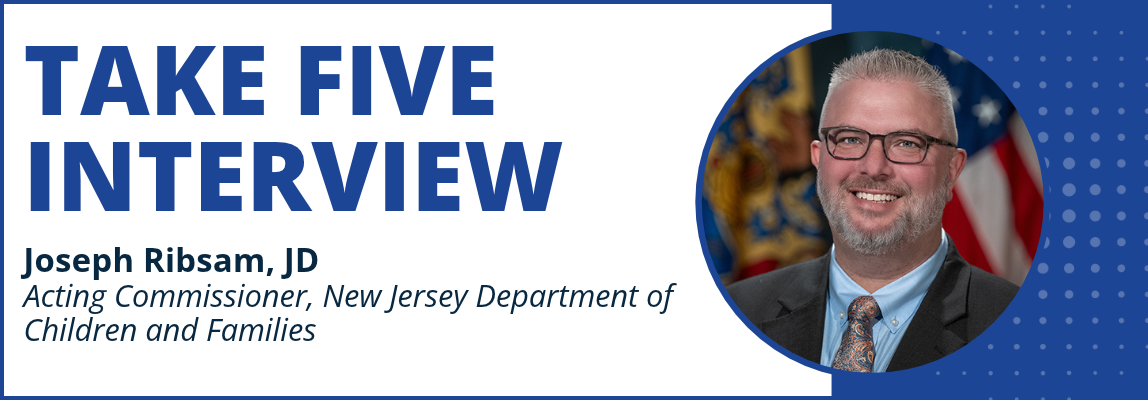
Joseph Ribsam was appointed Commissioner of the New Jersey Department of Children and Families (DCF) in 2026. He began his career at DCF in 2008 as legal counsel, later serving as Assistant Commissioner for Legal, Regulatory, and Legislative Affairs and as Deputy Commissioner. He went on to spend more than five years as Director of New Hampshire’s Division for Children, Youth and Families, where he led development of a statewide children’s behavioral health system of care, and then served as Director of Child Welfare and Juvenile Justice Policy at the Annie E. Casey Foundation.
What are your top priorities as commissioner?
I started my career here at DCF, and coming back, I was pleasantly surprised by the progress that’s been made. Right now, I’m largely listening and soaking it in, but a few priorities stand out.
One is dignity and respect for the people we serve. It’s easy to go straight into solution mode without understanding what families’ lives are like, and to miss that they’re often facing institutional barriers and systemic problems a parent education course won’t solve. We need to treat people with empathy and partner with them to figure out what they need.
Another is aligning the Department, so its divisions complement one another. Many families in our child welfare system also come to our Children’s System of Care, our community-based supports, or our Division on Women, and we need to meet their needs across all of those.
But the biggest area of my attention will be youth mental health. Our system of care is a model for the rest of the country, but coming out of a youth mental health epidemic, demand for care has grown, and stigma has decreased, but at the same time the workforce has shrunk. We’re seeing backlogs I hadn’t seen before. If we don’t meet those needs, they bleed into the child welfare and youth justice systems.
Where do you plan to focus your energy first?
The youth mental health system is where I need to put a lot of attention right away. We need to be thoughtful about our next steps, but we can’t take too long to start meeting need.
One critical aspect of the system of care that has lost some focus over the years is the balance between clinical supports and relational supports, like family peer support and youth peer support. Our care management is based on a wraparound model, which focuses not just on connecting kids and families to clinical services, but on building natural and informal supports around the family. By the time an episode of care ends, that team should look very different than when it started. It’s no longer just clinicians and school staff, but family, people from a faith community, neighbors, coaches. With care managers stretched and carrying more cases than they should, I understand focusing on clinical needs when there’s a crisis in front of you. But we need to get back to looking at relational needs as well.
Is there anything from your experience in New Hampshire that you’d like to bring to New Jersey’s Children’s System of Care?
When I got to New Hampshire, there really wasn’t a children’s behavioral health system, so much of my work there was bringing lessons from New Jersey. Compared to New Jersey’s system of care, theirs is still young.
The one thing I focused on there that I’d like to bring here is the intersection of systems. There’s always been tension between the child welfare system and the system of care that we need to do a better job of resolving. Both the wraparound model and New Jersey’s child welfare case practice model focus at their core on the relational family component and on empowering families to make the right decisions.
In New Hampshire, I did that work at the intersection with youth justice. We built pathways so that when kids had contact with law enforcement, they were quickly engaged in the right services, often diverting them from the justice system entirely. New Hampshire ended up with the lowest per capita youth incarceration rate in the country and cut the number of kids on probation in half, and we did it safely, by meeting needs right away instead of waiting on court processes.
The Quality Institute’s Children’s Mental Health Mapping Report, commissioned by DCF, found that many families aren’t sure where to turn first when their child needs mental health support. What could make that entry point clearer for families?
I very much appreciate the Quality Institute’s work on the report. It reinforced some of what we already knew and elevated new ways to make our system more responsive to families.
We’re currently in a procurement process for our contracted systems administrator, which manages many of the back-office functions of the system of care, including our 24/7 hotline. Parents can call any time to get mobile response and stabilization services or schedule an evaluation in their home or community. In most states it would be a dream to have a hotline like that. Our challenge is that people don’t know it’s available, and that will be a key focus once the new contract is in place.
The bigger challenge, which the report also raised, is that the system of care mostly focuses on moderate to high behavioral health needs. Many families aren’t at that point yet, so they rely on their health insurance, whether commercial or managed care. We see a lot of variation in what’s covered, the hoops families have to jump through, and whether there’s an adequate network on the other side, or a ghost network where you call provider after provider and can’t find care. We need to align commercial payers, managed care, and the system of care so families can make sense of them and get what they need before they reach a crisis point.
Note: Families can reach New Jersey’s Children’s System of Care 24 hours a day, seven days a week, at 1-877-652-7624.
Finally, we like to ask a question beyond each person’s professional life. Is there anything you’re reading, watching, or listening to right now that you’d like to share?
I’ve been back for just a few months, and it’s been hard to find downtime. We just closed on a new home, so most of my reading lately has been reports on how DCF has changed since I left and instructions for assembling furniture. The prior owners also kept a really nice garden, and I’ve been researching how to care for it through the winter so it’s ready to come back to life in the spring. Fall is a great time to think about getting ready for new growth.