
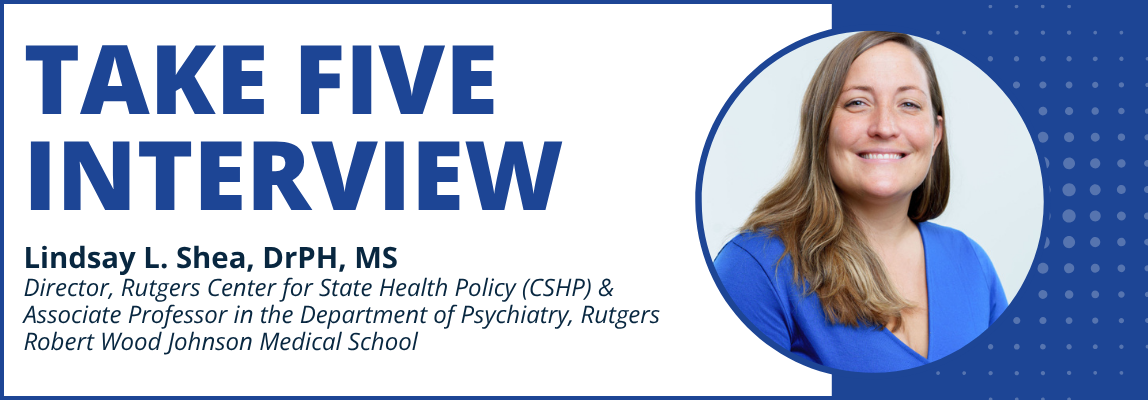
Lindsay L. Shea, DrPH, MS, is Director of the Rutgers Center for State Health Policy (CSHP), a role she began in July 2026. She also holds a faculty appointment in the Department of Psychiatry at Rutgers Robert Wood Johnson Medical School. Before joining Rutgers, she led the Policy and Analytics Center at the A.J. Drexel Autism Institute, where her research used large Medicaid datasets to study health and access outcomes for adolescents, adults, and older adults with autism.
What drew you to lead the Rutgers Center for State Health Policy, and what are you most excited about in the new role?
I have long followed the Rutgers Center for State Health Policy as a model for how to conduct rigorous, timely research while partnering with the people who are making decisions about policies and programs, so that both can exist alongside and inform each other rather than existing in silos. To be here now is a formative moment for me.
Part of my excitement is that I’m learning about a new state. Most of my work to date has been in Pennsylvania, and there are so many things about New Jersey that are unique and wonderful, and challenging, that I’m learning about every day. I give credit to the Center’s team, who have been doing this work for decades and are helping me learn how I can be as effective as possible for New Jersey.
What health policy issues do you see as the most important for the Center to focus on in the coming years?
I’ll focus on two. States right now are experiencing an influx of new information, restrictions, and changes for people enrolled in Medicaid. That makes decisions and priorities about basic health care all the more important. How do we make sure people can access primary care when and how they need it, so that we can keep people as healthy as possible, support them in navigating health care, and prevent the emergencies and crises that come from lacking access to primary and preventive care?
The second is that much of my career has been focused on autism, disabilities, and intellectual disability. There’s a lot of good work we’ll be able to do to bring forward evidence on how people with disabilities can best be understood, how they can communicate their needs, and how they can access the services they need to be in their communities and thriving.
You’ve said that data should be used to reduce inequity, not just describe it. How do you plan to keep the Center’s data work connected to community experience and make sure it translates into real policy solutions?
I think part of the reason my work in autism and disability continues to compel action is that, as researchers, we produce a lot of descriptive information, but we are far less incentivized to take the next step and link that data to policies and programs we can change. I see it as our responsibility to use data with transparency for the populations it comes from and connect it to action.
At the Center, that means thinking about community in two ways: the New Jersey residents who need and use services, and the stakeholders who make decisions about how health care is structured in the state. Both perspectives matter, because those decisions affect hundreds of thousands of people. So we have to use data in a way that reflects people’s experiences and make sure that evidence reaches the people who make decisions.
In your prior work, you used Medicaid claims data to study access to care among adolescents with autism. What other big health policy questions could Medicaid claims data help answer for New Jersey?
Medicaid funds almost half of births in the United States, and about 60% of births in Latine communities. I think we can do a lot more work on understanding maternal morbidity and mortality using Medicaid claims data across New Jersey. That data reflects many babies, which means many birthing people, and their families. When we support people giving birth, and support babies in getting what they need for their health, we’re supporting entire families. And when we leave them behind, the ripple effect is large.
We can also continue to dig into the claims data to understand specific outcomes and look at subgroups across New Jersey, including people living in rural communities, and ask questions about their access and differences in their outcomes. That data can inform policies and programs that make a big difference.
Finally, we like to ask a question beyond each person’s professional life. Where is your favorite place to spend time outdoors?
My favorite hike is in a state park very close to my house. It goes by a creek, it has a huge incline, and usually you’re the only person there. It is the kind of place where you can reflect on what’s going on in your life, move your body, and think about your professional life too. Some of the most formative ideas I’ve had about my own career have come in the woods. We all have those special places, and even when life circumstances take you elsewhere, to playgrounds or shorter walks, continuing to find ways to reconnect to them is really important.