This week, President Trump issued an executive order urging states to disregard long-standing, evidence-based recommendations on child and adolescent vaccines. Fortunately, New Jersey took the legal steps to decouple its vaccine requirements from the federal government and instead link them to trusted non-political sources such as the American Academy of Pediatrics. I fully expect that New Jersey will continue this proven path for vaccination requirements.
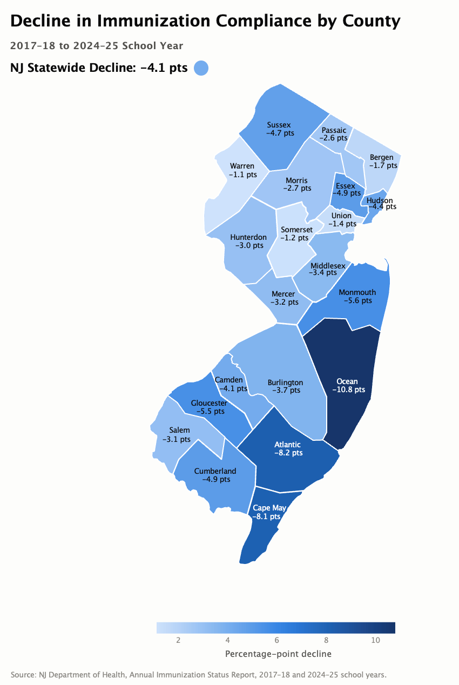
Despite state requirements, however, the share of New Jersey children meeting immunization requirements statewide fell to 91.3 percent in the 2024-25 school year, the lowest point in the eight years of data the state makes available, and the second year in a row of decline. In every county, New Jersey’s compliance rate has fallen since 2017-2018, ranging from a 1-point to almost 11-point decrease. This is a troubling trend that, if it continues, will inevitably lead to outbreaks and harm.
Within the statewide data, there are large differences amongst immunization rates in the counties. While rates in all counties declined, some experienced steeper decreases. Ocean County, for example, has declined in nearly every year since 2017-18, from 94.0 percent compliance down to 83.2 percent — a nearly 11-point slide over eight years. Monmouth, Gloucester, Atlantic, and Cape May show similar features: a steady, sustained decline consistent with more families opting out.
Immunization data from the last two years available —the 2023-2024 and 2024-2025 school years— shows that the compliance rate decline is accelerating in about three quarters of the counties in the state. Nineteen of 21 counties saw their rate drop in 2023-24 and sixteen dropped again in 2024-25. Within that two-year period, fourteen counties declined in both years. Not surprisingly, the statewide compliance rate fell a full 2 percentage points over those two years.
In working with our members, we hear from family physicians and nurses that there simply isn’t enough time in their busy well visits to make the case for vaccination, especially when a parent comes in with their mind already made up. And the herd-immunity rationale, while true, doesn’t seem to move people in the way it has in the past. It may be that it’s too abstract, that our society has become more individualistic, political messaging, or that faith in institutions has declined and eroded trust in public health, or perhaps, that we haven’t had an outbreak in a while and it doesn’t feel like a real threat. Whatever the reasons, we need to rethink our approach and timing for these conversations. We need people to know what a vaccine does for their child or baby, for themselves, for their grandparents.
So what should New Jersey do? Target outreach and resources at the specific counties and districts where compliance has fallen the most, rather than spreading a single campaign evenly across a state where most counties are still doing well enough. Provide vaccination messaging upon scheduling and at office visits, through written materials, videos, and other means. Get these messages out in the community. The state should equip trusted local messengers with specific, clear materials that make the case for vaccines personal. One resource I particularly like is from the American Academy of Pediatrics. It explains why the current vaccine schedule is safe and how not following it could put your child and others at unnecessary risk.
As kids head back to school this year, we’ll be watching these numbers closely, and we hope you will too.