
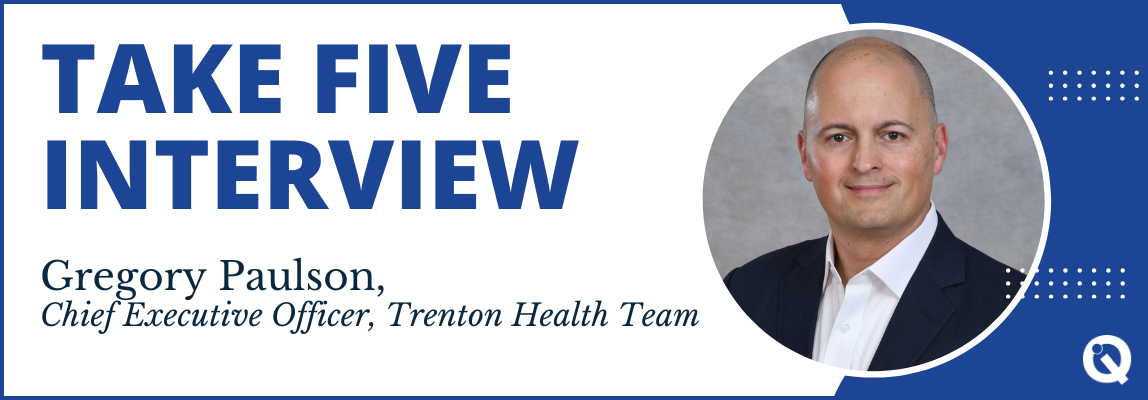
Gregory Paulson, CEO, Trenton Health Team, is a member of the Quality Institute’s Community and Social Support Council.
Trenton Health Team, a New Jersey designated Regional Health Hub, recently helped the City of Trenton earn the Robert Wood Johnson Foundation Culture of Health Prize, a national recognition of communities driving systemic improvements in health and wellbeing. Trenton is the only community in New Jersey ever to earn the prize. What changes do you hope residents will begin to see now that Trenton has received this award?
Hopefully, residents have already been seeing those changes. The prize is really a recognition of accomplishments as a community, not just of individual projects or initiatives. I hope the award encourages people who may not know Trenton well, or who only know it through outdated perceptions, to take another look. There’s tremendous work happening here and many positive stories unfolding throughout the Trenton community.
What initiatives did the Trenton Health Team, in partnership with Capital Health and other partners, put in place to gain this recognition?
It’s important to remember that this award honors efforts across the entire community. Trenton Health Team and Capital Health co-led the application, but the work recognized is truly collective. Our role has been to provide a team of trained Community Health Workers with knowledge of the community who can help individuals navigate the services available and to advocate for their own and their families’ health and wellbeing. We also convene and support collaboration among organizations focused on health and wellbeing and provide actionable data and analysis to help ensure that our collective work delivers meaningful impact.
How can residents and community organizations help sustain and expand this “culture of health” in Trenton?
I hope this recognition strengthens our shared belief that we’re on the right track. There’s still much more to do, but the prize highlights the collaborative culture that defines our community. A central part of that culture is elevating resident perspectives — ensuring that people with lived experience aren’t just informing the work but leading it. That’s how we make sure nonprofit and community partners remain responsive to what’s needed most in Trenton.
What opportunities exist in Trenton to advance health equity, and how will this award help?
We’ve been working together to address the community conditions that lead to inequitable health outcomes — from food access and economic development to maternal and infant health, housing, and chronic disease management. Our goal is to make Trenton a community where the environment supports people in achieving health and well-being on par with anyone else in the state, rather than serving as a barrier.
Finally, beyond your professional life, can you share an experience that shaped who you are today?
My professional life really started as a personal passion. I began volunteering as an EMT 30 years ago, and that experience shaped how I see people and community. Working as an EMT and later a paramedic helped me connect with people from all walks of life and understand the challenges they face in their daily lives. It keeps me grounded and reminds me to keep that human connection at the heart of everything we do.