
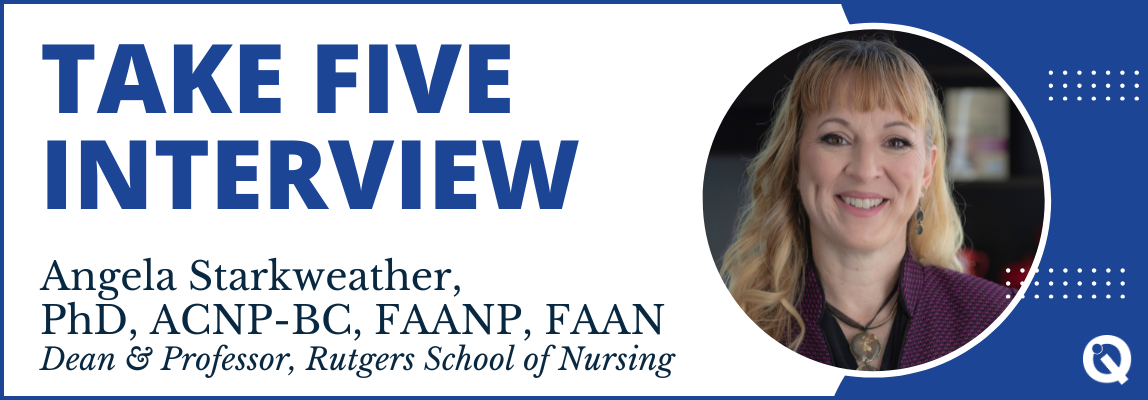
Angela Starkweather, PhD, ACNP-BC, FAANP, FAAN, is Dean and Professor of Rutgers School of Nursing. The school is a member of the Quality Institute’s Education Council.
You’re stepping into this role at a pivotal time for nursing. Can you share one major goal for the school?
One of our main goals is addressing the nursing shortage because New Jersey is expected to have a 10% shortage of registered nurses (RNs) next year. New Jersey is one of 10 states with the largest projected RN shortage in the nation by 2036. Rutgers School of Nursing has invested heavily in expanding the number of students admitted to our baccalaureate programs — from approximately 400 students in 2023 to over 700 students across our traditional 4-year, accelerated, and RN-BS programs in Newark, New Brunswick, and the 2+2 program in Blackwood. As an institution with a strong focus on research, this enormous increase in enrollment is rare. Educating baccalaureate-prepared nurses requires a heavy investment of resources. However, we are proud to be one of the top programs in the nation to invest in the nursing workforce. We are also focused on providing a range of pathways for students. Our total number of students now exceeds 2,000 annually across programs. These include nursing students pursuing graduate degrees in advanced practice, education, leadership and administration or as PhD-prepared nurse-scientists.
New Jersey, as well as the nation, faces a growing nursing shortage. What do you see as the barriers to increasing the number of nursing graduates?
According to the American Association of Colleges of Nursing, there were over 65,000 qualified applicants turned away from entering nursing school in 2023. So, it is not about finding people who want to pursue a fulfilling career as a nurse. Instead, the potential bottleneck is having enough nurse faculty, adequate clinical sites, and classroom space for students to learn. We also need more willing clinical preceptors to mentor students. Typically, graduate-prepared nurses who move from full-time practice to an academic career must take a substantial pay cut. To address this, we are working to recruit and retain faculty who find fulfillment in an academic career; build a supportive and healthy work environment where our faculty can thrive in teaching, research scholarship, and service; and strengthen our academic-practice partnerships. Without a shared investment in developing our students, our students will not meet clinical education requirements for graduation, set at a minimum of 500 hours. Other states across the nation have provided state funds for schools and colleges of nursing to expand enrollment, but in New Jersey, the financial responsibility is left to the individual institutions. At Rutgers School of Nursing, we also are working with nursing schools and colleges across the state to mitigate the shortage.
How is research, including your own research, shaping the school’s priorities?
My research has been focused on identifying the mechanisms of chronic symptom trajectories, such as pain, fatigue and sleep disturbances, and developing and testing interventions to reduce the individual’s symptoms and improve their quality of life. We’ve recently had several nurse scientists join the School of Nursing to broaden our research portfolio and we have mapped out our major areas of research and scholarship. A number of our faculty have established programs of health systems research with a strong dedication to health equity. We recently launched our Center for Health Equity and Systems Research to provide an infrastructure for collaboration in advancing these areas of science and practice. We also have an impressive track-record of research and service to the state of New Jersey through the FXB Center that was founded on advancing family-centered HIV health care and is also leading important work in child welfare, HIV prevention, workforce development, and population research. Our school’s research priorities have definitely broadened over time with a continued focused on advancing health equity across populations, health systems research, and improving maternal and infant health outcomes.
Rutgers is involved in innovative approaches to healing, including the use of music in health care. How will these innovations shape the way nurses are educated and the care they provide?
The concept of whole person health, which is very congruent with the “lens” of nursing, speaks to the notion of health in all its dimensions; physical, psychosocial, and spiritual. We want our students to be attuned to addressing all the dimensions of health for each individual, for those living with a disease and for those who are disease-free. The arts, including music, can be a powerful tool in the healing process — and access to these tools can improve patient perceptions on the quality of their care and satisfaction. In collaboration with the Mason Gross School of the Arts, we are exploring innovative ways to bring the “Art in Health” experience to our students and several of our nurse scientists are investigating how music and other forms of art can influence health and healing.
Finally, beyond your professional life, can you share an experience that shaped who you are today?
My experience of growing up in a rural area in Washington State provided an insightful perspective on how quality health care varies and how the influence of social, economic, and policy factors affect accessibility to health care. Being a nurse and a woman in science has shaped who I am and ignited a vision of how impactful nurses can be in improving safe and high-quality health care across settings. I also believe that spending a decade of my life as a single mother of three amazing children — who are now grown — shaped who I am. I understand the challenges people face when they want to pursue nursing or an academic career, especially while balancing family and life responsibilities. That experience gave me a deep appreciation for the mentorship and support systems people need to thrive, enjoy their work, feel a sense of belonging in their community, and to lead important work that improves people’s lives and their health care experiences.